

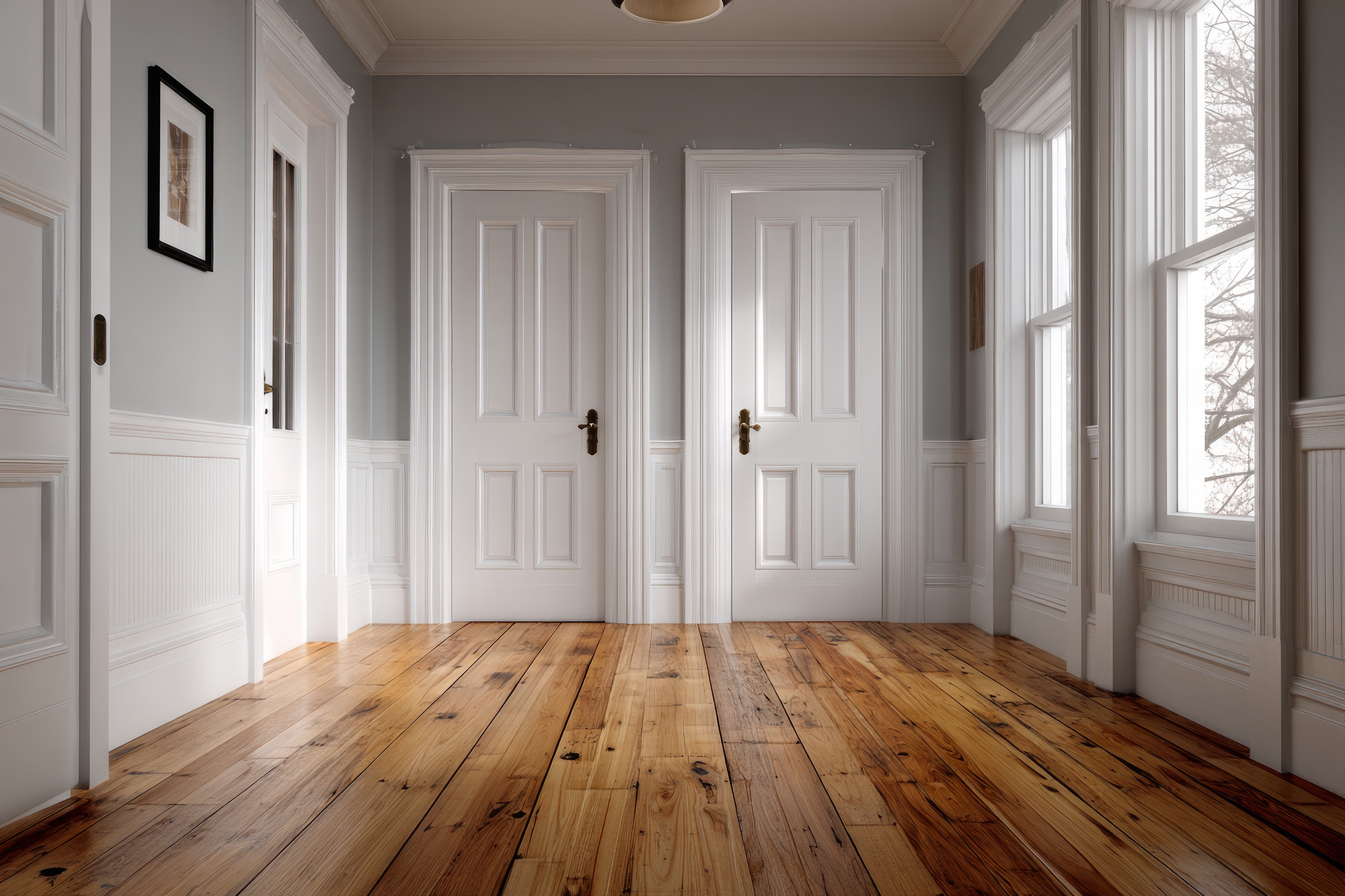
The Perimeter Is Where Movement Has Nowhere To Go
Every hardwood floor is installed with an expansion gap around the outside of the room, hidden underneath the baseboard or shoe molding. That gap exists so the whole floor can move as a single unit when indoor humidity changes. What most homeowners never hear is that the perimeter boards themselves are the most mechanically restrained boards in the room. They sit against a fixed wall on one side, they are often face nailed or blind nailed more tightly near the wall because the installer had less room to work, and in many homes the shoe molding is accidentally nailed down through the flooring rather than into the baseboard alone.
When indoor humidity falls in autumn, every board in the room wants to shrink slightly across its width. Boards in the middle of the field can shift a fraction of a millimeter in either direction and relieve that stress. Boards trapped at the perimeter cannot. The shrinkage force has to go somewhere, and it concentrates exactly where the floor meets the wall. That is the mechanical reason the perimeter shows stress before the field does, even though the wood in both places is identical.
Site Finished Floors Crack Differently Than Prefinished Ones
This is the part that almost no flooring article explains, and it changes how you interpret what you are seeing. When a floor is sanded and finished in place, the finish flows across the seams between boards and cures into one continuous film covering the entire floor. That film physically bridges board to board, a condition installers call side bonding. It creates a beautiful seamless look, and it also means the finish is now structurally linked across boards that are about to move independently.
When those boards shrink in fall, the continuous finish film has to tear somewhere. It typically tears along the line of greatest restraint, which brings you right back to the perimeter. Prefinished hardwood behaves differently because each plank is finished separately at the factory before installation, with a micro bevel at the edges. There is no continuous film bridging the boards, so seasonal movement shows up as slightly wider seams rather than cracked finish. Neither behavior is a defect. They are two different systems responding to the same drop in humidity.
Why Registers, Exterior Walls, And South Facing Rooms Go First
The cracking rarely appears evenly around every wall in the house, and the pattern is diagnostic if you know what to look for. Perimeter sections directly above or beside a forced air supply register dry out faster than the rest of the room because they receive the driest, warmest air first every time the furnace cycles. Exterior walls behave similarly, since the wall cavity and rim joist behind them sit closer to outdoor conditions than an interior partition wall does.
South facing rooms add a third factor. As the sun angle drops through autumn, direct sunlight reaches deeper into the room and lands on floor sections that were shaded all summer, warming and drying those boards on a daily cycle the rest of the floor never experiences. If you map where the cracking appears in your own home and find it clusters near registers, exterior walls, or in the path of low autumn sun, you are looking at a humidity distribution issue rather than a flooring failure.
What Actually Helps And What Does Not
Managing indoor relative humidity through heating season is the genuinely effective step, and most manufacturers point to a range roughly between 35 and 55 percent. A whole home humidifier tied into the furnace holds that range far more consistently than a portable unit, which tends to condition one room while the rest of the house keeps drying out. Slowing the seasonal swing matters more than hitting one exact number, because it is the speed of the change that concentrates stress rather than the humidity level itself.
Refinishing a floor that cracks every autumn without addressing indoor humidity usually reproduces the same result within a season or two, since the new finish will side bond exactly as the old one did. If you are choosing new flooring and your home historically runs very dry in winter, that is worth discussing upfront. Prefinished options within our hardwood selection handle seasonal movement differently than site finished floors do, and knowing which behavior you prefer is more useful than discovering it after the first heating season.
Have Someone Look At The Pattern Before You Refinish
Where the cracking appears tells an experienced installer far more than the cracking itself does. Our team has walked through this seasonal pattern with homeowners across Rochester Hills, MI, South Lyon, MI, Pontiac, MI, Troy, MI, Novi, MI, Walled Lake, MI, Rochester Hills, MI, South Lyon, MI, Pontiac, MI, and Troy, MI and can usually tell from the location whether you are dealing with humidity, restraint at the perimeter, or something else entirely.
Visit either of Rochester Hills, MI to talk it through, or contact us at Perfect Floors to have someone evaluate your floor before heating season fully sets in.


